





2022 – Who would have thought…
2022! Who would have thought…
… we would be going onto our third year since Covid made its first dramatic entrance. Two+ years of talking of nothing but ‘lockdown’, ‘mandatory’, ‘isolation’ or ‘quarantine’. No more ‘do you think it will rain today’ more like ‘have you been vaccinated’. April 2020, my first thought was ‘what’s going to happen to me and my work’. Well, I shouldn’t have worried one little bit. Yes, Davaar teetered for 2 seconds but my boss, whose brain never shuts down much, has come out of it for us. Long story short, Wendy continued to think outside the box.
Davaar workshops and supervision went from face-to-face to Zoom. So even though quite a few of our workshops and supervision appointments were cancelled or temporarily postponed, we also picked them back up due to no travel, organising training rooms, venues, or catering. Thank you Zoom. Also, a very big positive was the early development and forethought of Davaar’s Online Training. Yes, we may have wobbled a bit but we continue to grow stronger.
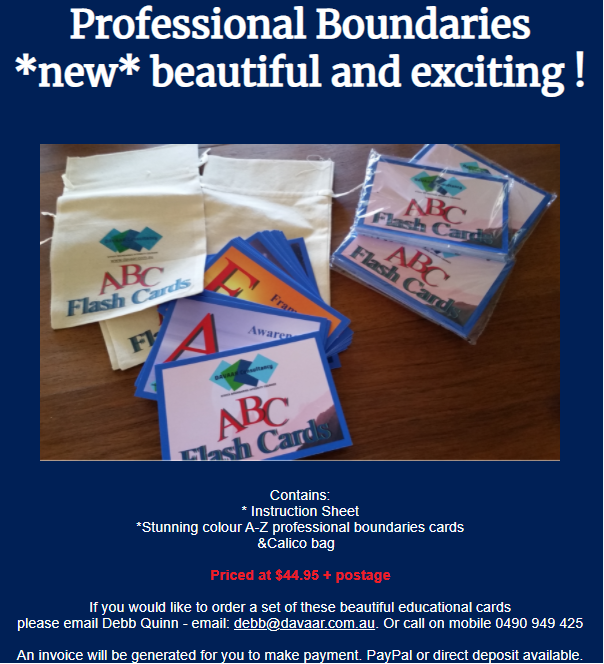
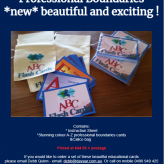
Early this year, Wendy came up with ‘Professional Boundaries Flash Cards’. We designed cards of the alphabet with beautiful scenery per letter. For example, ‘A’ stood for ‘Aware’, ‘Alert’, ‘Appreciate’.
Professional Boundaries Flash Cards
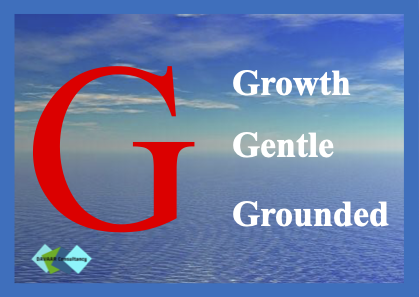
- Aware: refers to self-awareness of the professional in relationship with the client.
- Alert: remain alert to subtle changes in the dynamics of the professional relationship words spoken and behaviour.
- Appreciate: the unique journey that you experience in the professional relationship with clients you see.
This theme continues through to the letter ‘Z’, in full colour and complete with a calico carry bag.
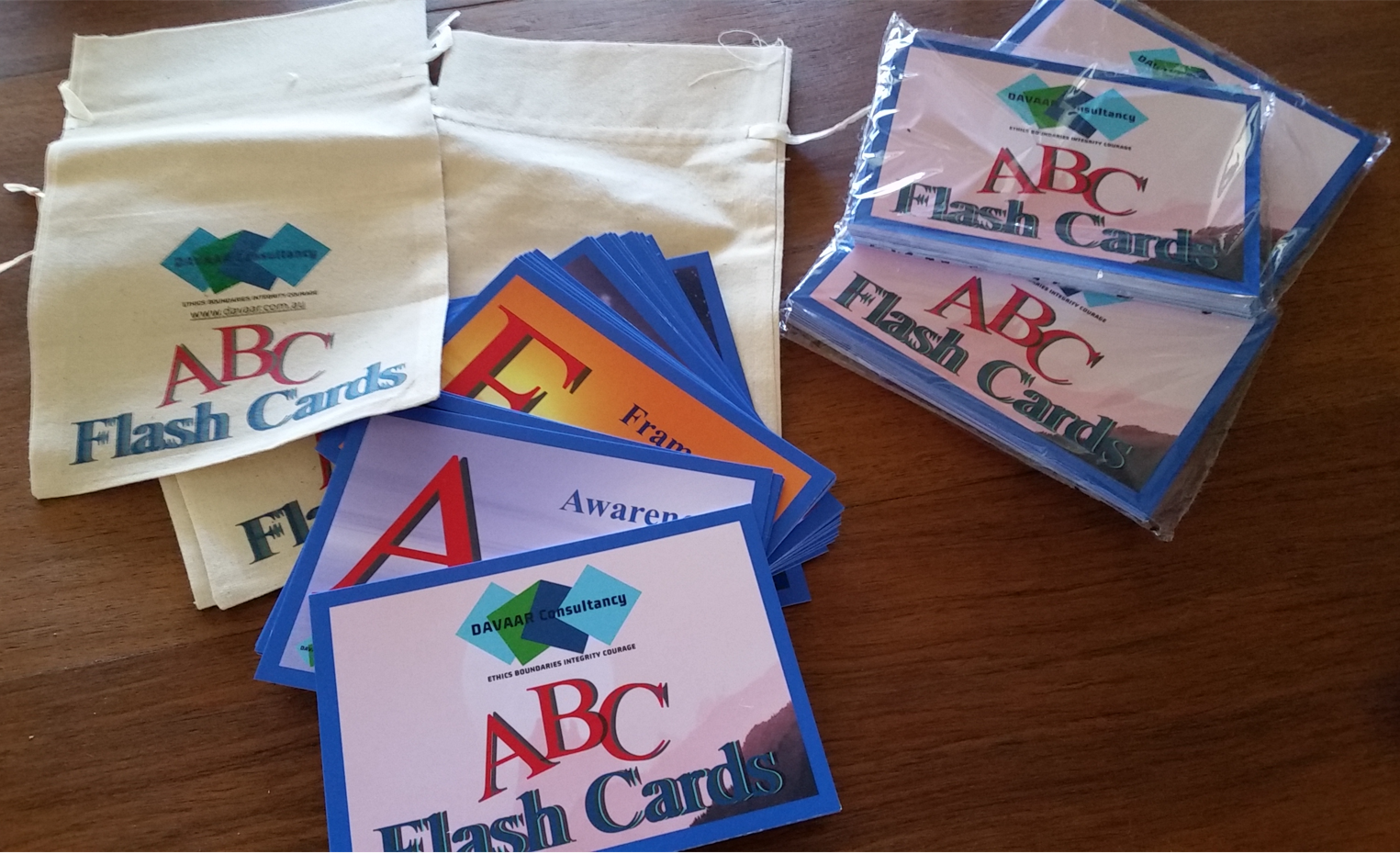 These flashcards were designed to be used to facilitate discussion about boundaries and what different words mean for participants in face-to-face and virtual workshops. A very different approach and one that will be a lot of fun when used. Click one of the images to learn more.
Enter 2022. Wendy will continue focussing on professional boundaries.
Wendy first started teaching the importance of professional boundaries in 2005. The theme she discusses in her podcasts (the Podcast Book is now complete), and in the Safe Professional Boundaries internet tool, resonate with people around the world from a number of different professions including health, teaching, and prison officers. In 2022, at Davaar, we will continue to build on the body of work we already have through a series of videos and other education options.
Something exciting to us that must be mentioned here, and something we are very proud of, is that the professional boundaries podcast has been picked up by the School of Health and Social Care, at Edinburgh Napier University to be used in their curriculum.
2022 will also be the year that Wendy will release a series of videos on professional boundaries. These will be available for 5-minute viewing before deciding to purchase.
Now, a little bit about Wendy that you may not know … she is a passionate Rotarian. She, and her friend Sue, came up with the Charter, Global Nurses & Midwives Rotary Club (GNMRC), which officially kicked off in late December 2020. It is a wonderful and exciting new Rotary chapter and one that I have been honoured to assist Charter President Wendy with developing certificates, guestlists, shirts, posters, videos, etc. At the end of December 2021, we asked members to send short videos of themselves, their family or home which we would put together to celebrate a) One Year of the new club, b) Christmas, and c) Friendship. It was a great review of the year and a lot of fun.
Davaar continues to proudly support GNMRC and projects that the club is doing for nurses & midwives around the world.
In the meantime, whilst isolating at home, my veggie garden hasn’t looked so good in years. An abundance of peas and beans (some of which ended up with the cattle), mini capsicums, and corn. The best part of growing your own is ‘bartering’ with the neighbours. I supply my neighbours with lemons and mangoes, and they exchange with limes, blueberries, and cucumbers.
I sometimes wonder if this is what will continue happening in the foreseeable future with the different strains threatening us. All I need now is a milking cow and a paddock of wheat (and a bread maker!).
Till next blog, stay strong, stay safe.
Debb
Why Rotary for Nurses & Midwives?
Why indeed?
A very special podcast this time – with the exciting news that a new Rotary Club being formed for a very special group. Announcing the new Provisional Global Nurses and Midwives Rotary Club.
Episode #31: Dr Wendy McIntosh on Rotary for Nurses & Midwives
https://nmemporium.com/index.php/2020/10/11/rotary-for-nurses/
Sue Walker (of Nurses for Nurses Network and Nursing CPD Institutex) and Charter Member of Provisional Global Nurses and Midwives Rotary Club poses the question: “… why is our nursing and midwifery voice not being heard where decisions about how health and community services are delivered?” So, why ARE our nursing and midwifery voices not being heard? How do we even start to get people to listen and truly hear what is being said? Wendy has a solution.
In the first half of the podcast, Sue talks to Wendy about her role as a Rotarian. What is involved in becoming a Rotarian? Wendy describes her role, experiences and contribution as a ‘newbie’ Rotarian (joined 2011) who is ‘humbled by being a citizen of the world’. ‘Is there a place for nurses and nursing skills in Rotary’? Wendy takes us on her 30-year journey of nursing & 9 years of Rotary, meeting like-minded enthusiast Sue Walker along the way and together with the leadership group, putting their heads together to form the Global Nursing & Midwives Rotary Club (GNMRC).
In the second half of the podcast, in the discussion between Sue and Nic, the listener learns that 50% of the global health workforce are nurses and midwives, yet the profession’s representation in policymaking, at the political level or in the boardroom is at best… scant. Through volunteering, fundraising, grants, exchange programs, sponsorship – Sue and Nic talk about a perfect platform for lasting change; understanding others’ needs, getting involved and making an impact both locally and internationally.
It IS indeed exciting times. As we come towards the end of the International Year of the Nurse and Midwife the chartering of a Rotary Club specifically for Nurses and Midwives is a great initiative – a global opportunity to join a tribe.
Working together as a team, Sue, Wendy & Nicole Nash-Arnold (Nurse Manager HQ) … you couldn’t find a more interesting and formable combination of passion and experience to introduce this exciting new concept to the world. There’s that ‘e’ word again … exciting. When listening to this episode you can feel the enthusiasm, and yes, again, excitement, our speakers share with their listeners.
As Wendy asked … what’s possible? Let’s be challenged and let’s figure out a way to meet those challenges.
2020 International Year of the Nurse and Midwife … “This is our Time”.
Read MoreTenderness is about you looking after you
Tenderness is about you looking after you
This is my first blog in a long time. Such a long time in fact that my PA Debb took it upon herself to write a blog to get the blog energy back into Davaar. How fantastic is that and what a funny blog she has written, I trust you enjoyed it and smiled as much as I did… Starting out with Davaar
The theme of tenderness was created in me a couple of years ago during a supervision session with a group of supervisees. As one of the group was describing work she had done with a client, I experienced a great softening and tenderness in her whole being. When I shared what I experienced with her and the group, the supervisee moved deeper into tenderness with herself. Her body softened further, her body relaxed more. As she got more tender with herself, I became aware that I experienced increased tenderness for her. It was such a touching and vivid few minutes for me. As I kept reflecting on the interaction between us and the experience for both of us, I wondered about the power of tenderness and the absence of acknowledging tenderness in our language today.
Trying to locate information about tenderness in the literature has been difficult. I am going to be bold and state there is a dearth of information about tenderness in contemporary literature. Perhaps, that in itself is a clue: if we are not writing about tenderness, not talking about tenderness, not exploring tenderness with each other, and in groups is it possible, then, that tenderness does not exist?
Of course, tenderness exists I hear you say. Ok, so reflect further – how often do you use the term in your work with clients, or thinking about and interacting with colleagues, or expressing tenderness with loved ones? Do a quick check-in now and respond to the following:
1. When you hear or think about the word tenderness – what presents for you (colour, image, name, person etc……allow your creativity to create)
2. In what ways do you demonstrate tenderness with a client?
3. What factors trigger tenderness in you for another person?
I have been running workshops on the theme of ‘Tenderness – Looking After You’ for a couple of years and from those workshops, it is clear that participants struggle with the notion of tenderness for themselves. I concur with them that tenderness may not be an easy idea, concept, experience to grasp. Then I notice an interaction from a participant, I experience their tone of voice, a shift in their body position and I say to the person – “what’s happening for you right now?”, they pause, they respond, I propose “this is you being tender with you right now” and their body softens more. “There you go,” I say “deeper into your own tenderness”. From interactions such as this, a whole new world of understanding about what tenderness means and how tenderness is experienced by that person (and the group) opens up. Is it possible that tenderness is simply about being with self or being with another in a gentle tender way?
The first known use of the word ‘tenderness’ was in the 14th century. According to the Cambridge Dictionary tenderness is defined as “the quality of being gentle, loving or kind”. Other descriptions of tenderness that I have found in the literature include:
- a feeling of concern, gentle affection or warmth
- a pain that is felt when the area is touched
- a tenancy to express warm compassionate feelings
- concern for the welfare of others.
I think of the tenderness, the softening that can occur for adults and other children around a newborn baby. I smile in tenderness when I experience an infant taking those first tottering steps and falling down. I sit in tenderness with clients when they share their heartfelt and heart wrenching experiences of workplace bullying, of losing themselves in traumatising and cruel systemic processes. I experience tenderness when clients share the moment they knew that they had made a significant positive impact on the life of a patient they provided care to.
Imagine if individually we took more notice of tenderness. Notice how we experience tenderness, notice how we share tenderness. As we notice, we collect all those tenderness moments in a glass jar. As we see the jar fill up in and with tenderness, we can be reminded even in those harshest, darkest moments and days, that as humans we have an enormous capacity for tenderness. Enormous capacity to be tender with ourselves and with others….. now that is just heart-warming….. and tender.
Follow my blogs on… https://davaar.com.au/dr-wendys-blog/
If you are interested in attending our tenderness workshops visit our Events calendar or email debb@davaar.com.au or wendy@davaar.com.au for more information.
We’ve scheduled a 3 module workshop via Zoom.
Dates/times: Wednesday 16th September, Wednesday 23rd September, Wednesday 30th September 
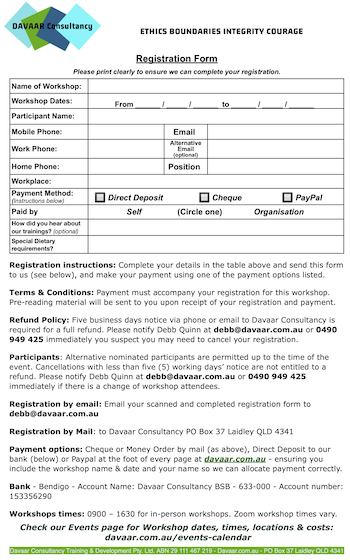 our registration form